
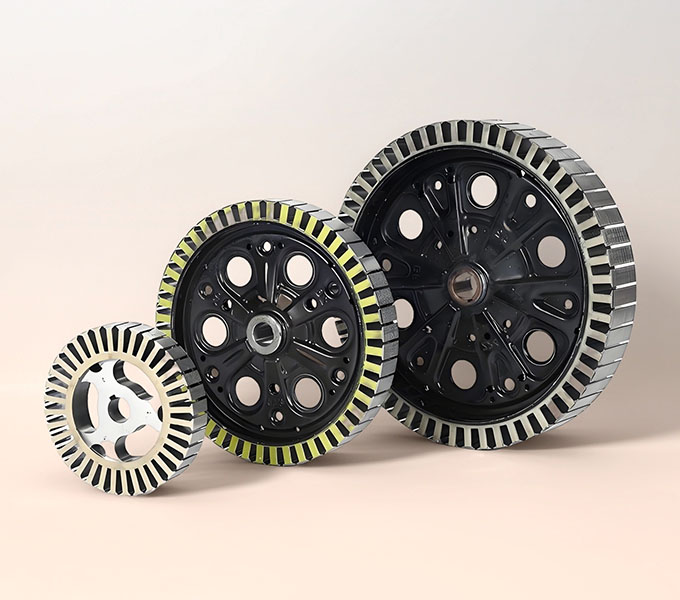
Achieving unparalleled power density and efficiency in your rotating machines begins with a stator core engineered to the finest tolerances. At Sino, we deliver stator lamination stacks that are not merely components, but the foundational element of electromagnetic performance, mechanical stability, and thermal reliability in your next-generation generators. Our vertically integrated manufacturing and materials science expertise enables us to provide you with stator cores that directly address the industry’s most pressing challenges: minimizing core losses, managing complex thermal loads, and ensuring structural integrity under extreme operational stresses. By partnering with us, you gain access to a spectrum of advanced materials, precision manufacturing processes, and collaborative design optimization services, ensuring your generator designs achieve their maximum theoretical performance in the field. We translate your most ambitious specifications into tangible, high-performance hardware, forming the magnetic and structural backbone of your machinery.
A generator’s heart is its stator core. The quality of that core decides how well the machine works. Sino laminations are designed to give you the best results by focusing on key areas to boost your generator efficiency.
The biggest job of our laminations is to reduce core loss. This loss comes from two main problems:
By cutting down on energy loss, our laminations produce less heat. This prevents dangerous hot spots and makes heat dissipation much easier. This helps the entire machine avoid damage from thermal aging.
Our stacked lamination design helps with noise reduction and provides a stable base for the machine’s magnetic circuit, leading to smoother operation. To achieve this, we use structural FEA to predict the deformation modes of the stator and can modify the design (e.g., by adjusting yoke stiffness or using advanced bonding for damping) to minimize noise at critical frequencies.
Our smart designs help you get more power from a smaller machine. We work to improve the power density of your generator. This means you get a stronger performance without needing a bigger footprint.
A stator core is not simply an electromagnetic component; it is a complex mechanical structure and a critical part of the generator’s thermal management system. Our engineering team collaborates closely with your designers, using advanced simulation tools to navigate the trade-offs between electromagnetics, structural mechanics, and thermal management to deliver a fully optimized core.
The foundation of a great stator lamination is the stator core material itself. Our engineering process begins with a collaborative analysis of your application’s magnetic requirements.
We maintain in-house capabilities for testing key magnetic properties, including B-H curve tracing, core loss measurement at various frequencies and flux densities, and measurement of interlaminar resistance.
We use the measured material data to inform our Finite Element Analysis (FEA) models. This allows us to accurately predict the core loss, flux distribution, and thermal performance of the final stator core under your specific operating conditions, enabling data-driven material selection rather than relying solely on datasheet values.
Material Class | Key Advantage | Primary Limitation | Typical Application |
NO Silicon Steel | Cost-effective, good all-around performance | Moderate core losses at high frequency | Industrial motors, standard generators, wind turbines |
High-Silicon Steel | Very low high-frequency losses | Brittle, difficult to manufacture | High-speed generators, specialized converters |
Cobalt-Iron Alloy | Highest saturation induction, high power density | High cost, complex annealing | Aerospace generators, racing motors |
Amorphous Metal | Extremely low hysteresis and eddy losses | Mechanically fragile, low saturation | High-frequency transformers, specialized motors |
The theoretical advantages of a chosen material can be severely compromised by suboptimal manufacturing processes. At Sino, we have refined every step of the manufacturing workflow to preserve and enhance the intrinsic properties of the lamination material, delivering a core that performs to its design potential.
The insulation between laminations is essential for blocking interlaminar eddy currents. We utilize a range of insulation coatings (C3, C5, C6) tailored to the application, from organic varnishes to high-temperature, high-resistivity inorganic coatings suitable for stress-relief annealing and welding.
The process of assembling laminations into a solid core determines the final geometric accuracy, mechanical stability, and overall loss characteristics. We can build cores in one piece or use stator segmentation for very large machines.
Consolidation Method | Advantages | Disadvantages | Best Suited For |
Welding (TIG/Laser) | High mechanical strength, low cost | Creates localized short circuits along the weld bead, increasing eddy current losses; induces stress | Robust industrial generators where a slight loss penalty is acceptable |
Cleating/Interlocking | Good mechanical strength, no short circuits | Can introduce stress around the cleat/interlock feature; may have lower axial stiffness | Medium-performance generators, applications requiring easy disassembly |
Bonding (Varnishing) | Excellent mechanical integrity, superior interlaminar insulation, dampens vibration and noise | Higher process complexity and cost; requires curing cycle | High-performance, high-frequency generators; applications requiring low acoustic noise |
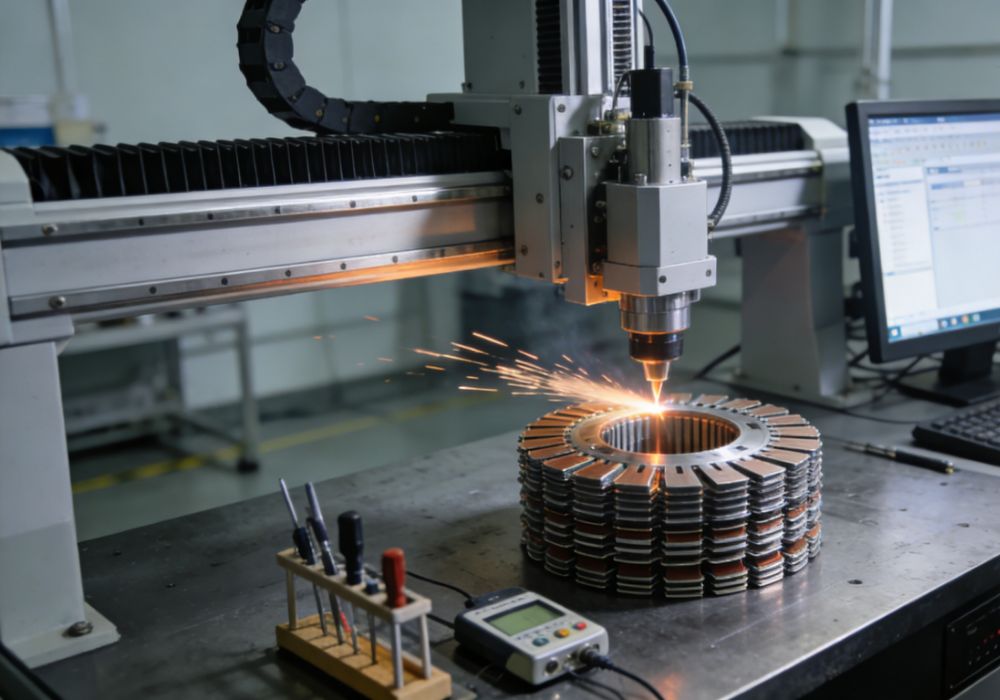
We are pioneers in the use of advanced, full-face bonding techniques. By applying a thermosetting adhesive to each lamination, the entire stack is fused into a monolithic block. This method offers:
The optimal stator core design is a direct function of the generator’s specific application. Our manufacturing flexibility and deep engineering expertise allow us to produce highly specialized stator cores optimized for a wide range of operational demands.
Feature | High-Speed Turbo-Generator | Low-Speed Renewable Generator |
Operating Speed | 10,000 – 100,000 RPM | 10 – 100 RPM |
Operating Frequency | 400 Hz – 2000+ Hz | 10 Hz – 60 Hz |
Lamination Thickness | 0.10mm – 0.35mm | 0.50mm – 0.65mm |
Material | High-silicon steel, CoFe alloys | Standard NO silicon steel |
Consolidation | Full-face bonding | Welding, cleating, bolting |
Architecture | Monolithic, small-diameter core | Large-diameter, segmented core |
Sino’s generator stator laminations are trusted in many fields. They are the driving force behind machines that power our world. Our parts are used in:
From a steam turbine generator and gas turbine generator in a combined cycle power plant to a turbogenerator used in nuclear power generation, our parts are there.
Our parts are used in heavy-duty machines.
We make parts for a reliable diesel generator.
Our engineering effort is to deliver the lowest total cost of ownership.
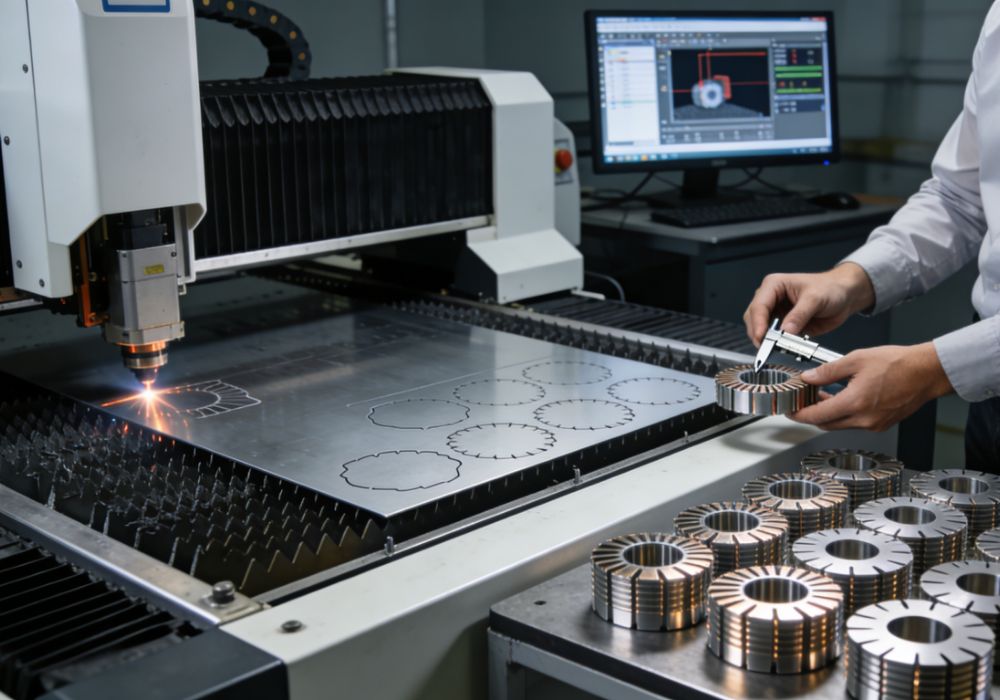
Are you ready to make your generator more powerful and reliable? The team at Sino is here to help. Contact us today to talk about your project. By choosing Sino, you are choosing a partner committed to excellence at every level. We provide the advanced technology, manufacturing precision, and strategic stability you need to build the next generation of world-class generators. Let’s build something powerful together.