
Applications

Lamination Stacks for Stepper Motor Manufacturer

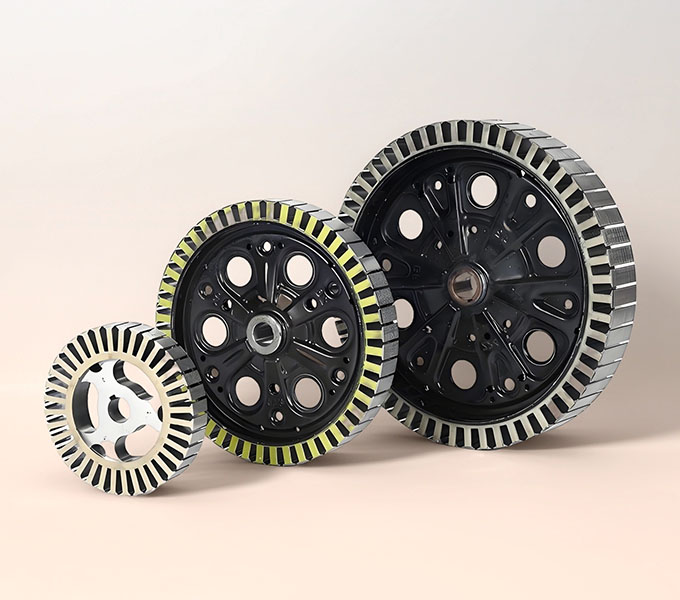
At Sino, we know that the lamination stack is more than just a support piece. It is the core of the motor’s magnetic system. It basically sets the limit for how well any stepper motor can perform. With Sino’s carefully made stepper motor laminations, you can make sure your motors provide the most power, very high accuracy, and great efficiency. Our high-quality stepper motor laminations are made to solve the big problems in motor design. These include getting more torque from a smaller size, making the motor more efficient, and reducing noise and vibration. This is important for everything from fast factory machines to precise medical tools.

Our goal is to give you more than just a part. We want to give you an edge over your competition. We do this through our deep understanding of magnetic materials and our use of modern manufacturing methods that protect the material’s magnetic qualities. We also work with you to design the perfect lamination shapes for your specific needs. We help you go beyond the usual limits of stepper motor design.

The Sino Advantage: More Power, Less Waste

Choosing Sino stepper motor laminations means you are investing in real, measurable improvements for your stepper motors. Our stepper motor laminations are the key to reaching a higher level of performance.
Much Less Wasted Energy

The biggest problem for motor efficiency is wasted energy. Our thin stepper motor laminations, made from high-quality electrical steel, are designed to prevent two main issues:

  • Eddy currents: These are unwanted currents that get wasted as heat. Our thin, insulated layers stop them from forming.
  • Hysteresis loss: This is energy that gets lost every time the magnetic field changes direction. We use special soft magnetic materials that make this change easier, which saves power.

By focusing on reducing power loss, your motor will run cooler and use less energy.

Higher Torque and Power

A stronger and more concentrated magnetic field means a more powerful motor. Our stepper motor laminations create an ideal route for the magnetic energy. This leads to:
  • High torque density. This gives you more turning force in a smaller motor.
  • Excellent power density. This is perfect for products where space and weight are very important.

Perfect Positional Accuracy

Stepper motors are all about being precise. Our stepper motor laminations are perfectly consistent. This creates a smooth and steady magnetic field, which greatly improves:

  • Step angle accuracy for perfect positioning.
  • Reduced torque ripple. Torque ripple is an unevenness in the motor’s turn.
  • Minimized cogging torque. Cogging torque is the jerky feeling you get when the motor is off.

This results in the smooth, slow-speed movement and exact positioning that your product needs.

The Right Material for Your Motor: The Foundation of Performance

Choosing the right soft magnetic material is the most important first step when designing stepper motor laminations. At Sino, we offer a wide range of materials. We also have the expert knowledge to help you pick the best one for your project.

Silicon Steels (Fe-Si Alloys)

Silicon steels are a very common and reliable material for many types of motors. This is because they offer a great mix of strong magnetic field capacity, easy magnetization, and good value.

  • Non-Oriented (NO) Grades: These are perfect for rotating machines like stepper motors, where the direction of the magnetic field is always changing. We offer a full range of standard M-grades (like M19, M27, M36, M47).
  • High-Silicon Grades: For products that need the lowest possible energy loss at medium to high speeds, we have special grades with up to 6.5% silicon.

Comparative Table of Representative Silicon Steel Grades:

Material Grade

Nominal Thickness (mm)

Max Core Loss @ 1.5T, 60Hz (W/kg)

Saturation Flux Density ($B_{sat}$) (T)

Primary Application

M47

0.50

5.80

~2.05

General Purpose, Cost-Sensitive

M27

0.35

3.10

~2.03

High Efficiency, Industrial Automation

M19

0.35

2.50

~2.01

Premium Efficiency, Servo/Stepper

6.5% Si Steel

0.20

1.20 (estimated)

~1.85

Very High Frequency, Low Loss

Advanced High-Performance Alloys

For products that require the absolute best performance, we are experts in working with several advanced materials.

  • Cobalt-Iron Alloys (Co-Fe): These materials have the strongest magnetic field capacity known (up to 2.4 T). This can greatly increase torque or allow you to make the motor smaller and lighter. They are the top choice for high-performance uses like aerospace parts and robotics.
  • Amorphous and Nanocrystalline Metals: These materials have very low hysteresis loss and work great at high frequencies. They are a top-of-the-line choice for special, high-speed motor designs.
  • Soft Magnetic Composites (SMCs): SMCs are made from very pure, insulated iron powder. The powder is pressed together to form a solid, custom-shaped part. Key Advantages:
    • Isotropic Magnetic Properties: This allows the magnetic field to travel in any direction (3D), which makes new motor designs possible.
    • Extremely Low Eddy Current Losses: This makes them perfect for small, high-frequency motors, especially in products like medical tools and car parts.

Made with Perfect Precision: Our Manufacturing Process

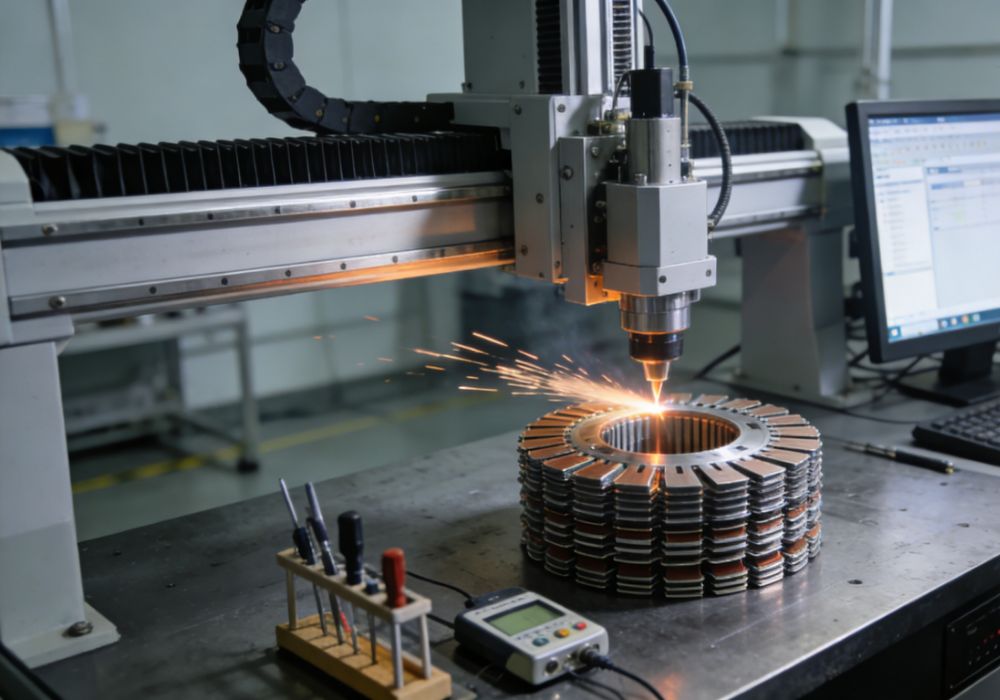
A material’s potential performance can only be achieved if the manufacturing process protects its sensitive magnetic structure. It is very important to understand how manufacturing affects the material. Its impact is often bigger than people think. Problems like stress from stamping, heat damage from laser cutting, and short circuits from welding can lower the magnetic performance by up to 40%. We use our own special manufacturing rules to prevent this damage. These methods include careful die management, fine-tuned laser settings, and special heat treatments to remove stress. This protects the quality of our stepper motor laminations.

Lamination Cutting and Shaping

  • Precision Stamping: For making large quantities of stepper motor laminations, our high-speed press machines are the best choice.
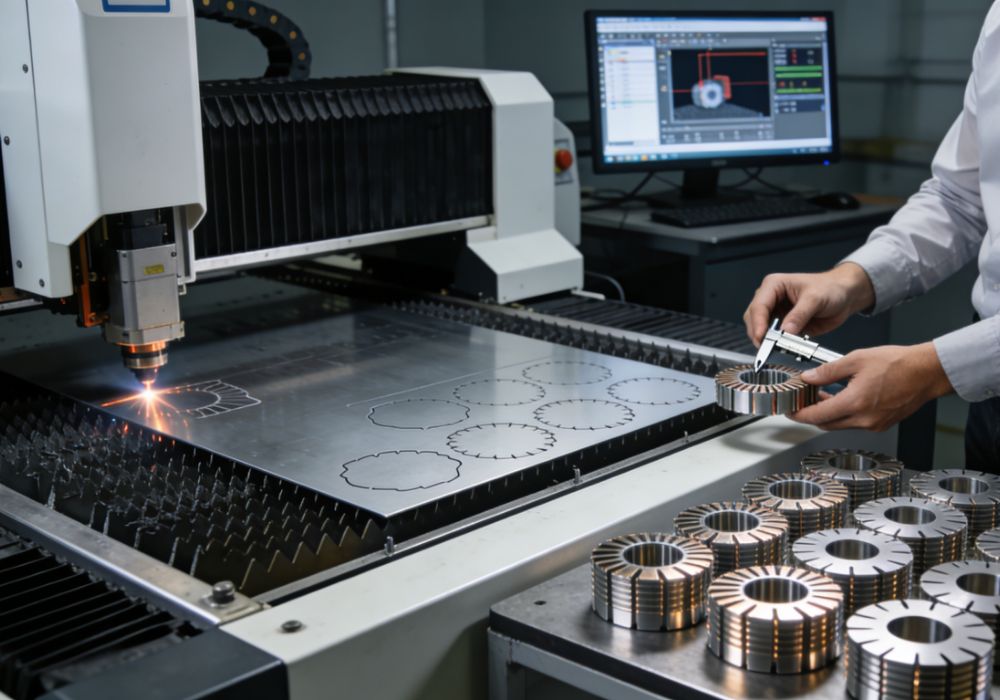
    • Burr Formation: As a cutting tool (die) gets older, it can create a small, rough edge called a burr. If the burr is too high, it can cut through the insulation on the next lamination in the stack. This creates a short circuit and greatly increases energy loss. Our internal standard requires us to maintain and replace our dies often. This keeps burrs smaller than 2% of the lamination’s thickness, which is a much tighter standard than what is common in the industry.
    • Induced Stress: The cutting action causes a lot of stress in the metal. This stress makes it harder for the magnetic field to work properly, which wastes energy. We fix this by putting the parts through a carefully designed heat treatment process after stamping to relieve the stress.
  • Laser Cutting:
    • Heat-Affected Zone (HAZ): Laser cutting creates a lot of focused heat. This heat creates a “damaged” zone where the magnetic properties are much weaker.
    • Mitigation: We use a special process to solve this. First, we adjust our lasers to use the least amount of heat possible. More importantly, all of our laser-cut stepper motor laminations must go through a carefully controlled heat treatment. This process happens in a special atmosphere and restores over 95% of the material’s original magnetic quality.
  • Wire EDM: For the most precise parts and for very thick materials, we use Wire Electrical Discharge Machining (Wire EDM). This method creates a perfect edge with no stress on the material.
  • Chemical Etching: This process uses chemicals to shape the part. It creates stepper motor laminations with perfectly smooth edges, no burrs, and no stress.

Lamination Stacking and Joining

  • Welding (Laser or TIG): The strong heat from welding melts the laminations together. This creates a large path for wasteful eddy currents. For high-performance motors, we recommend not using welding. If welding must be used for strength, we use special methods that barely penetrate the surface. We also place welds in areas where the magnetic field is weak to reduce their negative effects.
  • Adhesive Bonding (Full-Surface Bonding): This is the best way to get high performance. Before cutting, the steel coil is coated with a thin layer of a special glue (called Backlack). After the stepper motor laminations are cut, they are stacked and heated. The heat cures the glue, creating a strong, single-piece core. This method offers several benefits:
    • Superior Mechanical Stability: This stops the laminations from vibrating, which is a main cause of motor noise.
    • Excellent Electrical Insulation: The glue layer adds extra insulation, almost completely stopping energy loss between layers.
    • Improved Thermal Conductivity: We can use special glues that are good at transferring heat. This helps pull heat out of the stack and keep the motor cool.
  • Interlocking: This mechanical method connects the stepper motor laminations together. It creates a solid and reliable motor core with very little wasted space.

Building the Perfect Motor Core: Designs for Specific Applications

The best lamination stack is not a “one size fits all” product. We are experts at designing stepper motor laminations that are a perfect fit for the special needs of different industries.
  • High-Frequency / Low-Loss Stacks for Microstepping and Servo Applications: For these, we use very thin (0.1mm – 0.2mm) silicon steels with a high silicon content or nanocrystalline materials. Full-surface adhesive bonding (Backlack) is required to get the best possible insulation between the layers.
  • High-Saturation / High-Torque Stacks for Industrial Automation: We choose materials with the strongest possible magnetic fields, like low-silicon steels or cobalt-iron alloys. The stack must be very strong, so we use adhesive bonding or strong interlocking methods.
  • Miniature Stacks for Medical and Optical Devices: Soft Magnetic Composites (SMCs) are often a great choice here because they can be formed into complex 3D shapes. For traditional stepper motor laminations, we use laser cutting followed by heat treatment to create very fine details. These designs focus heavily on reducing cogging torque to make the motor run as smoothly as possible.

Powering Innovation Across Industries

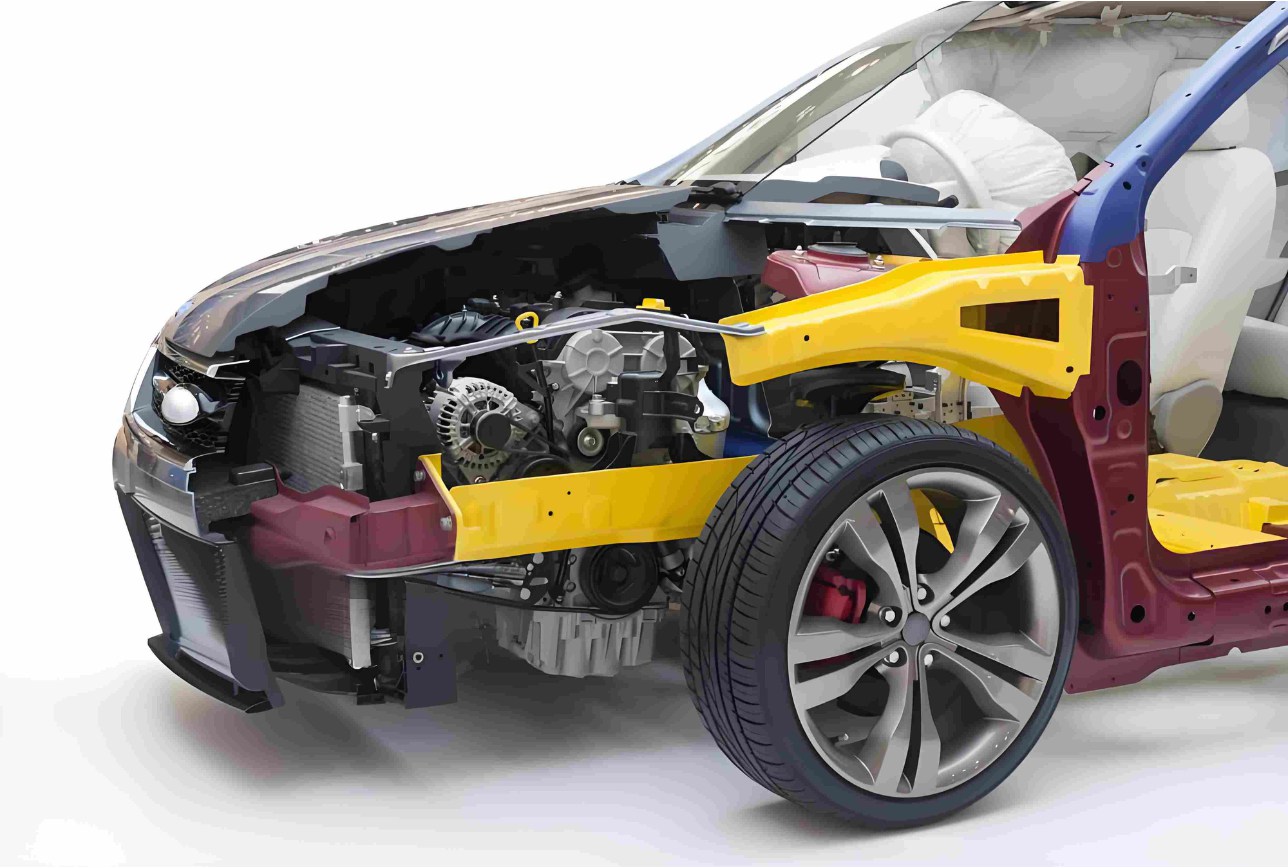
Sino stepper motor laminations are used by top companies in many industries. They are the quiet, dependable core of many machines.

01
1
Robotics and Industrial Automation
Our stepper motor laminations deliver the exact positioning and high torque needed for robotic arms and automated factory equipment.
02
2
CNC Machinery and 3D Printing
For machines that build things one layer at a time, being accurate is the most important thing. Our cores make sure every single step is perfect.
03
3
Medical Devices
In medical tools, being reliable can be a matter of life and death. Our high-quality stepper motor laminations are used in pumps, scanners, and lab machines.
04
4
Aerospace Applications
In the aerospace industry, parts need to be light, strong, and able to handle tough environments. Our advanced alloy stepper motor laminations are perfect for this.

Your Partner in Custom Motor Design

Do you have a special design challenge? Sino is not just a supplier. We are your partner in design. Our team of engineers is ready to work with you. You can send us your CAD/CAM files, and we can help you improve your design for better performance and lower cost. Our quick prototyping services, like laser cutting and wire EDM, mean you can get a real part to test in your hands very quickly.

Our Promise of Quality

At Sino, our name is our promise. We promise to deliver the highest quality stepper motor laminations available. Our quality control system meets or goes beyond the standards set by the National Electrical Manufacturers Association (NEMA), ISO 9001, IEC, UL, and ASTM International.

Contact Sino today to talk about your project. Let us show you how our high-precision stepper motor laminations can give you the power, efficiency, and accuracy you need to be a leader in your market.