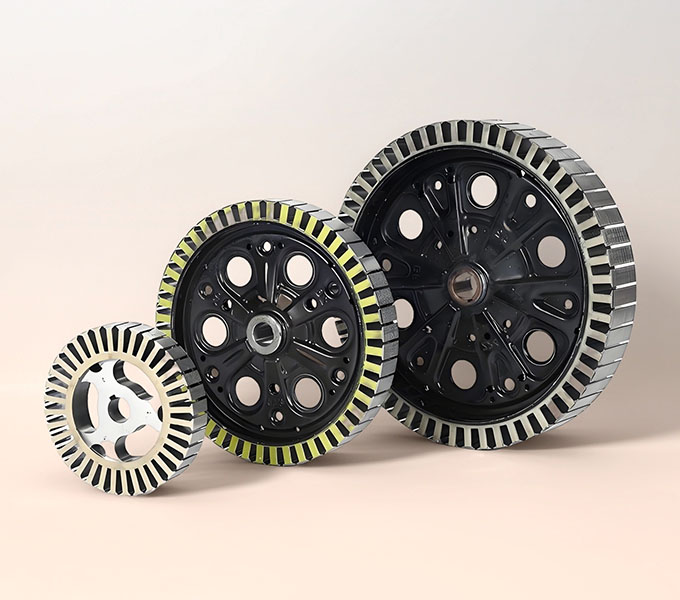
With Sino’s expert service for stator lamination welding, your motors will work better and for a longer time. The quality and strength of the stator core are very important for how well a motor performs. At Sino, we see stator lamination welding as a key technical skill, not just a way to join parts. Our special lamination welding makes your stator cores very strong. This directly makes your product work better, have more power, and be more dependable. This helps your motors use less energy and run more quietly. We give you a big head start with our complete lamination services that cover everything from beginning to end.
Our automatic stator lamination welding is fast and very precise. This means you get excellent parts every single time. We help you build the perfect motors for what you need. It doesn’t matter if you need just one test stator core for a new design or need us to make a large number of laminations. Sino is the ideal partner for making your stators and rotors.
A welded core gives your motors great power and strength. In every part we make, we focus on making the motor work better.
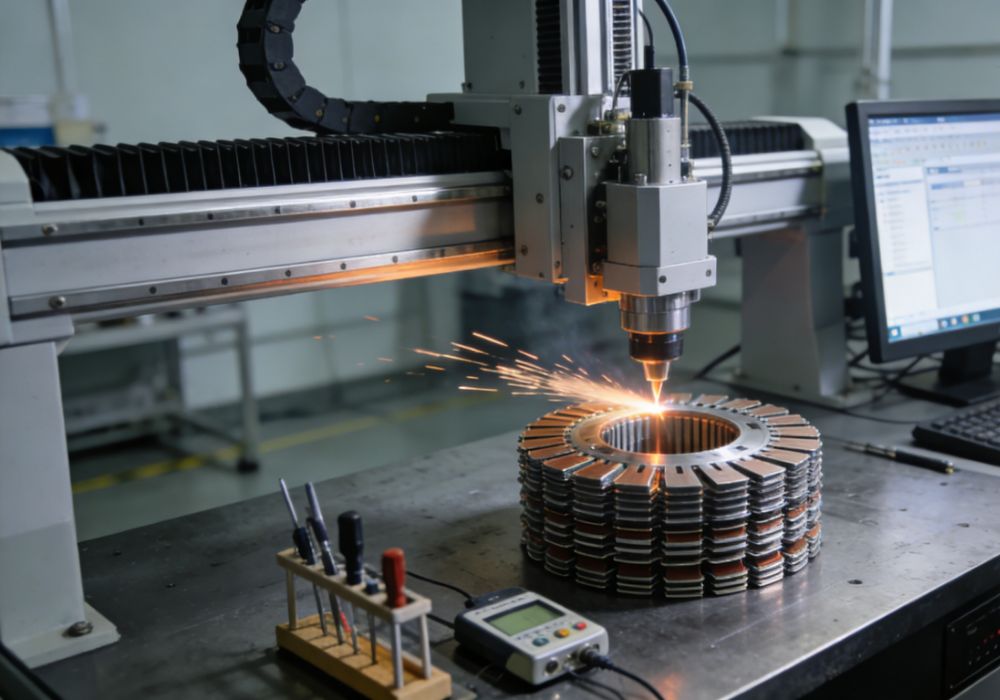
Our welds are very tight. This is important for lowering power loss from something called eddy currents. Too much heat from welding creates a big Heat-Affected Zone (HAZ). This bad area can damage the insulation and cause more power loss from eddy currents. Our special lamination welding method uses a very small, focused amount of energy. This results in a tiny HAZ. This method keeps over 99% of the insulation between the layers safe. It also protects the steel’s special properties that prevent energy loss. By stopping these eddy currents, our lamination welding also helps cut down on another type of energy loss called hysteresis loss. This means your motors will use electricity better and will not get as hot.
The lamination welding process turns the stack of laminations into one solid piece. We make sure the weld goes to the exact right depth, controlled to within +/- 5% of our goal. This makes the core strong without creating “short circuits” inside that can hurt the motor’s magnetic performance. The core will not bend or break, even when doing tough jobs. This is much better than older methods like staking and riveting.
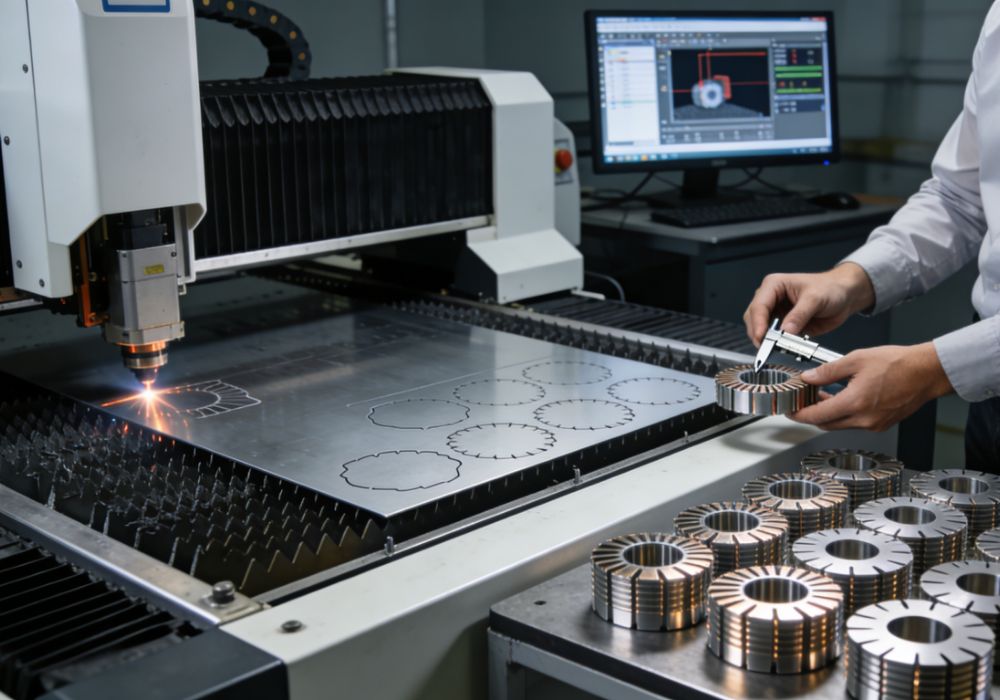
A strong core means less shaking. Before we start the lamination welding, we use special tools to apply even pressure to the stack. This gets rid of any air gaps and makes sure the core is dense and holds its shape. This is a very important step for a solid weld with no empty spaces. This leads to less Noise, Vibration, and Harshness (NVH). Your motors will run smoothly and quietly. This is very important for products that people use every day.
Successful stator core lamination welding requires careful control of important steps in the process. Our engineering teams use their many years of experience to make every step perfect for creating the best cores.
Critical Setting | Why It’s Important | How Sino Controls It | Direct Benefit for Your Motor |
Heat Input (kJ/mm) | Makes the HAZ smaller, stops damage to insulation, and keeps the good magnetic properties. | We use special power sources we can control very carefully, shape laser pulses, and set the right travel speeds. | Works Better: Less energy loss in the core. More Dependable. |
Weld Depth | Makes sure the core is strong without creating short circuits inside. | We watch the process in real-time, look at the metal under a microscope, and use our large database of settings. | Very Strong: Can handle high power and shaking. |
Weld Bead Shape | Affects where stress builds up in the part. | We use advanced tools to control the laser beam and special gas flows for TIG/Plasma welding. | Lasts a Long Time: Lowers the risk of the part getting tired and failing. |
Stack Pressure | Makes sure the laminations are packed tightly and prevents problems with the weld. | We use custom-made presses that are part of our lamination welding stations. | Correct Shape and Size: This is very important for controlling the air gap and keeping noise low. |
At Sino, we use the best tools for the job. We have many different types of technology. This lets us choose the best lamination welding method for any project, finding the right balance of performance, number of parts, and cost.
This is the best technology for motors that need to perform at a very high level. It uses the lowest amount of heat, makes a very small HAZ, and is amazingly accurate at high speeds.
This is a very controlled process that is known for being very exact and high-quality.
This is a more advanced version of TIG. It has more energy for deeper welds and faster speeds.
Feature | Laser Beam Welding (LBW) | Tungsten Inert Gas (TIG) Welding | Plasma Arc Welding (PAW) |
Heat Input | Lowest | Medium | Low to Medium |
Weld Speed | Highest | Lowest | Medium |
Accuracy & Control | Highest | High | Very High |
Best For | High-performance EV/Aerospace, thin laminations, high volume | Test parts, thick stacks, low-to-mid volume | Mid-to-high volume, deep weld needs |
Using the right material is a key part of a great motor. We adjust our lamination welding methods for the specific type, thickness, and insulation coating of your electrical steel. Because we know a lot about materials, we can solve common problems.
Material Feature | Welding Problem | Sino’s Solution and Method | Benefit for You |
High Silicon Content | The metal can be fragile and might crack. | We carefully control the heat to lower any leftover stress. | A strong core that keeps the great magnetic properties of high-quality steel. |
Thin Laminations | High risk of burning holes or bending the metal. | We use high-speed laser welding with low energy and special holding tools. | Makes it possible to use thinner laminations for high-frequency motors. |
Organic Insulation Coatings | A lot of gas is released, which can create tiny holes in the weld. | We use special laser pulse patterns and gas flows. | A strong weld with no holes that will be reliable for a long time. |
We make these shapes by using a lamination stamping process or with laser cutting laminations. We can use a progressive die stamping tool or rotary notching for difficult shapes. After that, we perform the stator stack fabrication and lamination welding.
Our setup is built to handle jobs of any size. We can support projects from research and development test parts to full-scale production for companies around the world. Our robot-run stations handle everything: loading the stack, pressing it, and checking it right on the line. This makes producing a large number of parts very efficient. Our flexible systems also let us switch between jobs quickly, making us a great choice for customers who need many different types of parts.
Our custom stator core assembly work is used all over the world. From North America and Europe to Asia, many industries trust Sino.
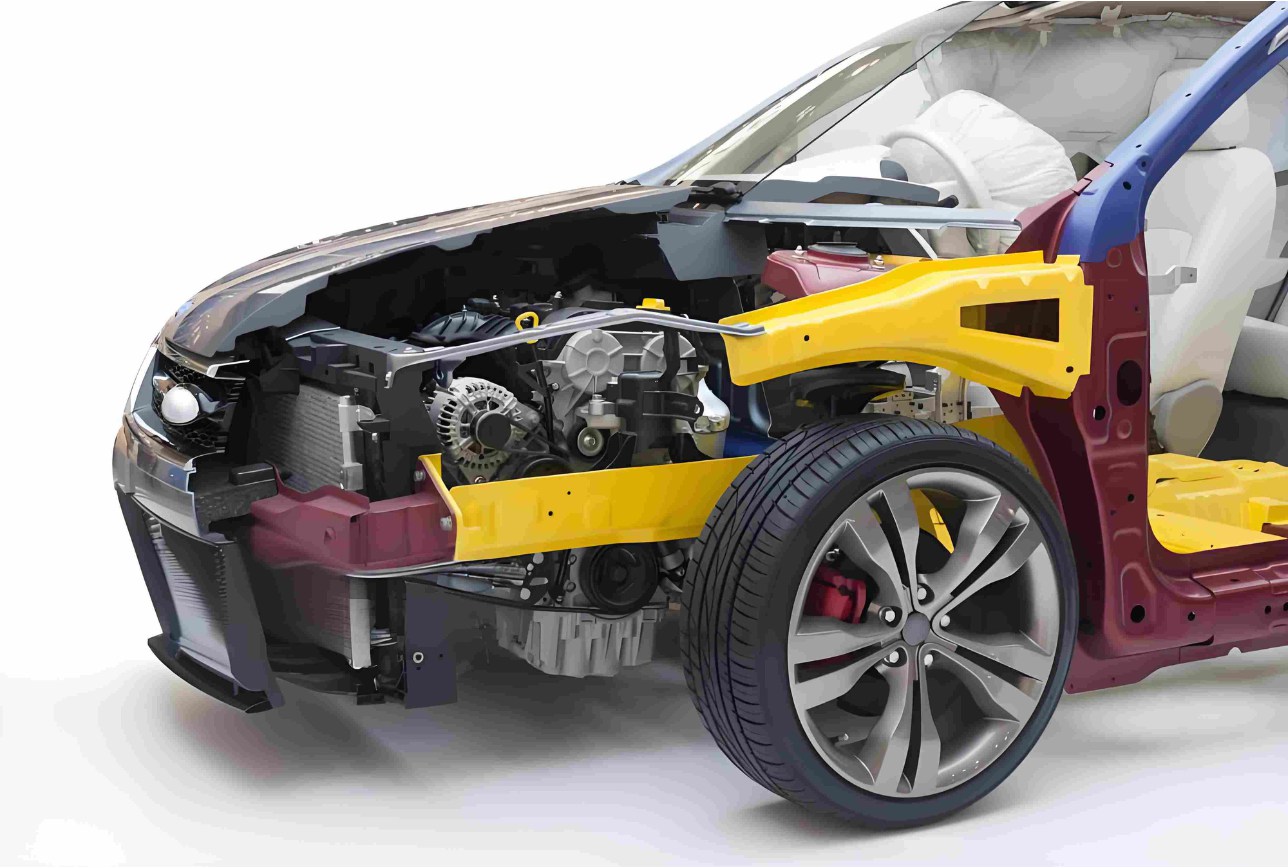
We are a major partner for making electric vehicle (EV) motors. Our automotive motor laminations are in many new cars.
We supply parts for strong industrial motors. These are used in big machines and robots. We also offer industrial motor repair services.
Our parts are used in clean energy systems. We build strong generator stator cores for wind and water power. We also help build high-frequency motor cores.
We make light and strong aerospace motor parts for airplanes and space technology.
Our work is in BLDC motor stator welding, servo motor components, and high-speed motor projects. We can make any custom motor lamination you need.
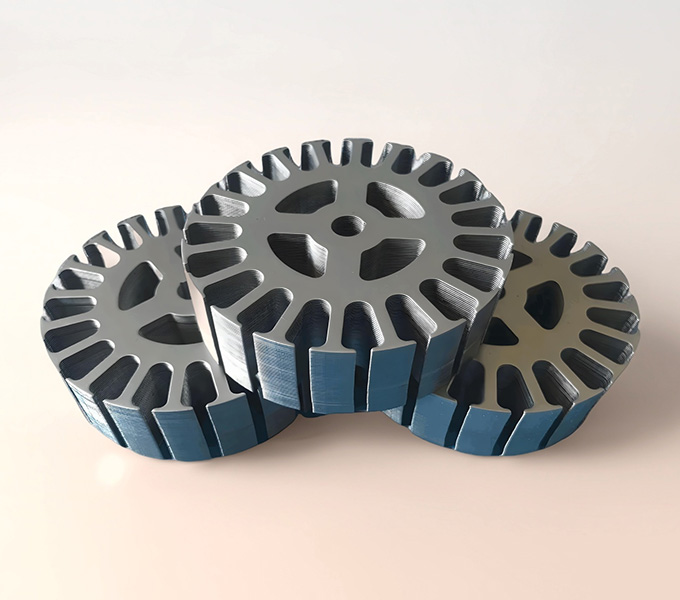
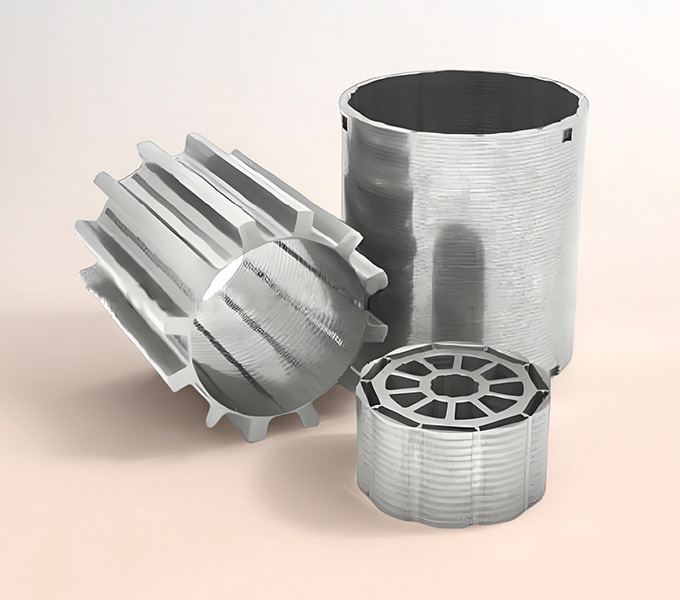
We check for quality at every step of our process to prevent any problems.
Testing that doesn’t damage the part (NDT): We use a full set of NDT methods. These include automatic camera systems, CMM to check the size and shape, and X-ray scans to check the inside of the part.
Testing that breaks a sample part (DT): When we are setting up the process, we do tests that break a sample. This includes looking at the metal under a microscope to confirm the weld depth, HAZ size, and the metal’s structure.
Checking the Performance: We give you real test data from electrical insulation and core loss tests. This confirms that our lamination welding keeps the steel’s low-loss properties and protects the insulation.
Choosing Sino for your stator lamination welding is a smart choice to work with us.
Working Together on Engineering: You can work directly with our engineers. They will give you advice on how to design for manufacturing to make your design better and save costs. We work with you from start to finish. Our Welding Engineer helps with important design choices like lamination thickness, stator shape, slot fill factors, and winding type.
Control Over the Whole Process: You get the benefit of our full control over the process. Because we control everything from the raw steel to the finished core, you can be sure the materials are always consistent.
Experience in Many Industries: You can take advantage of our successful work in demanding industries, including EV, aerospace, and factory automation.
We Are Always Improving: You can partner with a supplier that is always investing in the newest technologies to give you an edge over your competition.
The stator core is the heart of your motor. Trust Sino to design and make this critical part to the highest standards of quality and performance.
From our main factories in China to our partners in Germany, Sino is your global expert for stator lamination stacks welding service. Contact our engineering team to talk about your next project. Let’s build better motors together.